Home The science About Register interest

Why your nervous system
needs this right now.

Perimenopause starts to change the biology of stress. Hormonal shifts can affect how your nervous system regulates mood, sleep and emotional resilience. Understanding this helps explain why the techniques in Healthy Thinking work, and why they matter at this stage of life.

What perimenopause and menopause does to your hormones

This is not a gradual, smooth decline. It is a period of significant hormonal fluctuation, and your nervous system responds to those changes.

Oestrogen and progesterone do not simply decline. During perimenopause they often fluctuate unpredictably, while follicle stimulating hormone (FSH) and luteinising hormone (LH) rise as the brain struggles to stimulate the ovaries.

This hormonal variability can affect how the nervous system regulates stress, mood, sleep and emotional resilience.

Hormone fluctuations across perimenopause and menopause

Hormone fluctuations across perimenopause and menopause. Oestrogen, progesterone, FSH and LH.
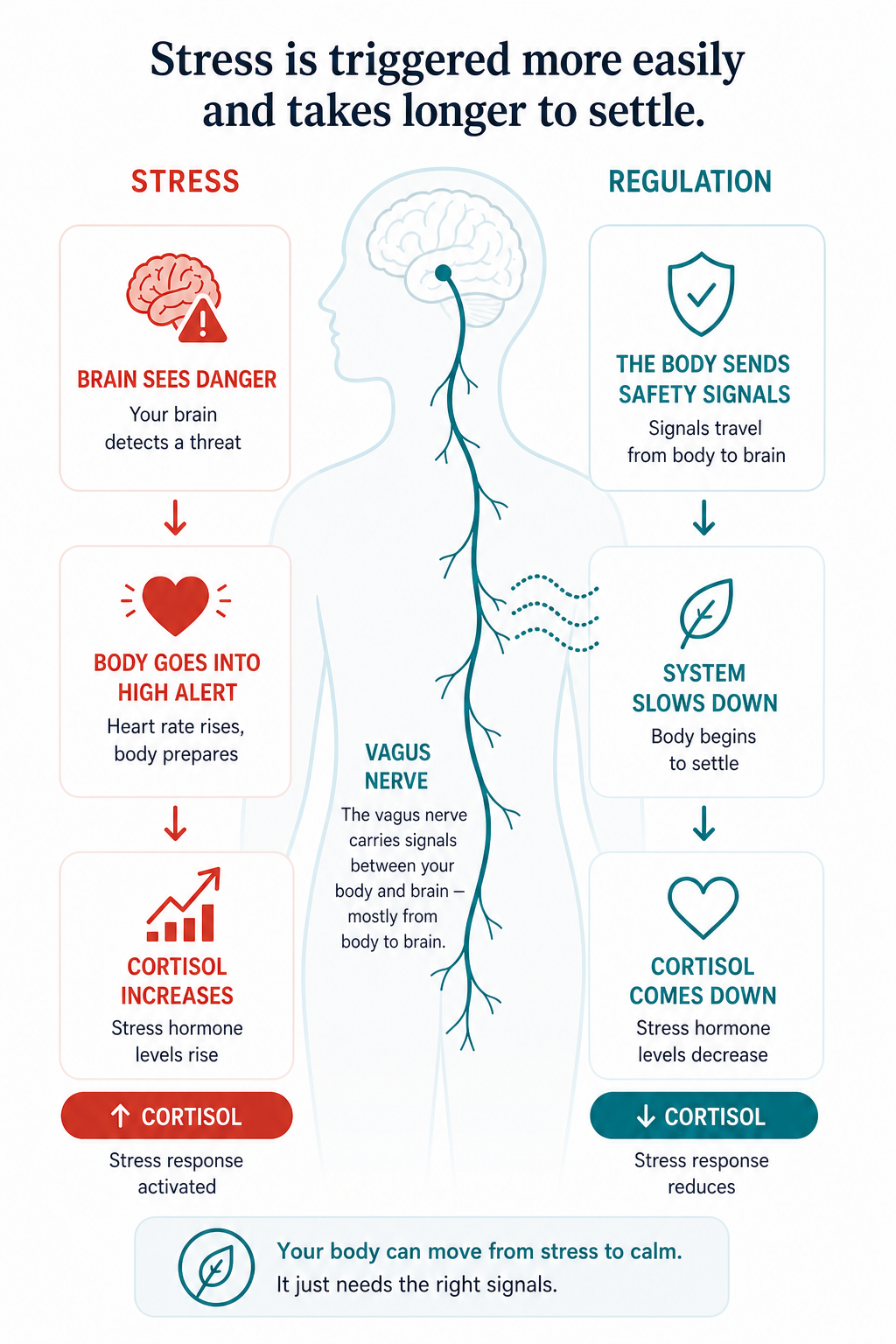
Stress is triggered more easily and takes longer to settle

Why stress fires more easily now ...and how to bring it back down

Oestrogen plays an important role in the body's stress response. It supports serotonin and GABA (chemicals involved in mood, calm and emotional regulation), and helps influence how the brain responds to stress.

As hormone levels fluctuate and decline during perimenopause and menopause, the brain's threat-detection system can become more sensitive. The alarm may fire more easily, and it can take longer to settle again.

This is why a conversation that would not have bothered you before now feels overwhelming. Why you snap at small things and then wonder why. Why your heart races for no apparent reason, or you wake at 3am with your mind already running. It is not weakness. It is biology. Your nervous system is working harder with less hormonal support.

The vagus nerve is part of the body's built-in calming system. Slow, diaphragmatic breathing helps stimulate vagal pathways and activate the parasympathetic nervous system, the body's 'rest and restore' response. This can help slow the stress response, support recovery and improve nervous system regulation.

Healthy Thinking works by giving your nervous system new tools to regulate itself, through the body, not just the mind.

Your body can move from stress to calm. It just needs the right signals.

Bottom-up regulation. Not top-down control.

Most stress management tries to change how you think. Healthy Thinking works with your body first, because the nervous system responds to the body before it responds to the mind.

Breathwork: Diaphragmatic and regulated breathing
Mechanism: Vagus Nerve Activation
Research shows that even a few minutes of slow breathing can measurably influence autonomic nervous system activity, helping shift the body away from fight-or-flight activation and towards greater physiological calm.
Guided relaxation
Mechanism: Amygdala-driven regulation
Guided relaxation in a receptive state helps the brain form new associations with safety and calm. Regular exposure to states of rest and reduced threat can lower stress reactivity over time and strengthen pathways involved in emotional regulation and recovery. This is neuroplasticity in practice, the brain adapting and learning through repetition and experience.
Grounding
Mechanism: Prefrontal cortex nervous system working
Grounding techniques help bring attention back to the present moment through the senses. This can interrupt cycles of anxious thinking and help the nervous system begin to settle, by signalling that the immediate environment is safe.
Visualisation
Mechanism: Nervous System
Guided visualisation can help create a felt sense of safety that the nervous system can begin to anchor to. With practice, this can support the body's ability to access calmer states, particularly during periods of heightened stress or hormonal change.

Grounded in science.

The approach behind Healthy Thinking draws on the work of leading researchers in neuroscience, psychiatry, behaviour change and women's health.

Amishi Jha
Neuroscientist, University of Miami
12 minutes of daily practice protects attention and working memory under extreme stress.
Peak Mind / Mindfulness Journal
Nadine Burke Harris
Former Surgeon General, California
Trauma is not the event. It is the body's response. Regulation is the intervention.
The Deepest Well
Bessel van der Kolk
Psychiatrist
Stress dysregulation is physiological. Body-first approaches work where top-down alone does not.
The Body Keeps the Score
Lisa Mosconi
Neuroscientist, Weill Cornell
The menopausal brain is neuroplastic and consistent regulation supports cognitive resilience.
The Menopause Brain
Albert Bandura
Stanford Psychologist
Self-efficacy is the strongest predictor of sustained behaviour change.
Psychological Review
Jim Doty
Neurosurgeon, Stanford
Compassion-based practices directly modulate the autonomic nervous system and reduce threat response.
Into the Magic Shop
Shahroo Izadi
Behaviour Change Specialist
Lasting behaviour change comes from self-understanding and kindness, not discipline and willpower.
The Kindness Method
Stacy Sims
Exercise Physiologist
Bottom-up regulation and mindfulness calm the nervous system, supporting recovery, sleep and sustainable exercise.
Protect Your Brain

How Healthy Thinking is different

Most wellbeing programmes focus on changing thoughts, building habits or providing information. Healthy Thinking starts somewhere else.

When stress levels are high, the nervous system can become stuck in a state of threat, overwhelm or exhaustion. In this state, it can be difficult to think clearly, make decisions, process information or use coping strategies effectively.

Healthy Thinking uses evidence-informed nervous system regulation techniques to help calm the body's stress response first. As the body settles, mental clarity, emotional resilience and the capacity for change can begin to return.

Traditional approaches often focus on

Understanding thoughts and behaviours
Education and information
Symptom tracking
Cognitive strategies
Building new habits

Healthy Thinking focuses on

Regulating the nervous system
Reducing physiological stress and threat responses
Supporting the body through periods of hormonal change
Developing awareness of personal stress patterns
Building sustainable regulation skills through daily practice

Rather than asking women to think their way out of stress, Healthy Thinking helps create the conditions that make change feel possible.

Healthy Thinking is a self-management tool and does not replace advice from your GP or other healthcare professionals. The research cited supports the general evidence base for the techniques used. Healthy Thinking is currently in pilot phase and outcomes data will be published following completion of the pilot programme.

The science is sound. The practice is simple.

Twelve minutes a day. Six weeks. Practical tools to help your nervous system find its way back to balance.

Register interest